
Planning for Travel Expenses
Travel is expensive. How can you control the cost and enjoy your trip?
TRAVEL
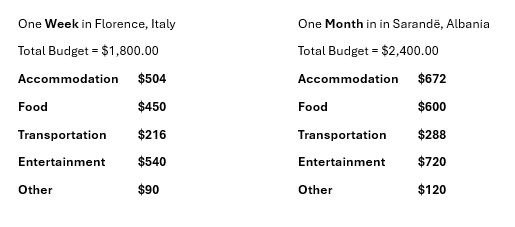
One Week in Florence, Italy. Total Budget = $1800.00
28% Accommodation $504
One Month in Sarandë, Albania Total Budget = $2400.00
28% Accommodation $672
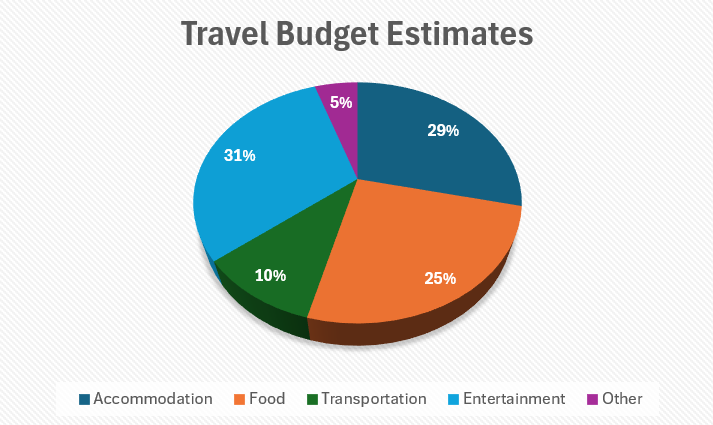
When it comes to travel, there are costs you can control and costs that you can’t. Knowing the difference is one key to success for any long-term traveler. A recent survey on Facebook asked travelers to share how much money they spend on accommodation. The average long-term traveler spends 28% of their designated budget solely on the housing where they will sleep, whether it’s a week, a month, or a year. This is an expense you can control by making a reservation in advance. Whether you prefer to stay in 5-star hotels, short-term rentals, or hostels, your accommodation budget can be established, and sometimes paid for, before you even leave home. Here are some examples.
If you’ve never been to a destination before, it can be difficult to guess the price of meals in restaurants, products in grocery stores, or snacks from a food truck. The website Numbeo has gathered much of that data for you. Numbeo is the world's largest cost of living database and a crowdsourced global resource for quality-of-life data. This tool is helpful when estimating your food budget in advance of your trip. Remember, it’s best to estimate, then round up to a higher number. Coming in under budget later is a real win.
Numbeo estimates that a meal for two at a Mid-range restaurant in Florence, Italy would cost about €80.00 per person, while a McDonald’s combo meal would cost €20.00. How many times will you eat out per day? Because food is also our entertainment, we generally plan $50-$100 per day for two people depending on our destination. If you really can’t get the numbers to work, then try estimating 25% of your budget.
One Week in Florence, Italy. Total Budget = $1,800.00
25% Food $450
Like Florence, Numbeo estimates that a meal for two at a Mid-range restaurant in Sarandë, Albania costs about €50.00 per person, while a McDonald’s combo meal would cost €10.00. Again, how many times will you eat out? If you aren’t sure, then plan to estimate 25% of your budget if you are a foodie.
One Month in Sarandë, Albania Total Budget = $2,400.00
25% Food $600
Bloggers and Vloggers who travel and share their budgets seem to have vastly different ways of calculating their transportation costs. Some travelers include the cost of long flights or cruises to arrive or leave a destination while others only calculate the cost for local buses, taxis, ride-shares, trains, tuk-tuks, or camel while they are traveling in a specific city or region. So, listen closely to HOW they calculate transportation costs before applying it to your own budget. The reasons Bloggers and Vloggers use different are important and will impact your own travel budget. There are variations in the starting destination, preferred travel styles (think first class or economy), luggage fees, and walkability differences amongst people.
Like the accommodation category, your pre-purchased transportation costs are controllable and known entities. The local transportation is harder to estimate, but Numbeo can help you with ground transportation costs in many cities or towns. During our first year of travel, we chose to combine the cost of cruises, flights, trains, ferries, and local transport into our costs and allocated 12% of our budget to this category.
One Week in Florence, Italy. Total Budget = $1800.00
12% Transportation $216
One Month in Sarandë, Albania Total Budget = $2400.00
12% Transportation $288
Regardless of which methods you use to estimate your transportation expenses, try to remember all the little costs and big costs that can have a compounding effect on your wallet. Remember to add extra money in this category if you have lots of day trips from your main destination.
One Week in Florence, Italy. Total Budget = $1,800.00
30% Entertainment $540
One Month in Sarandë, Albania Total Budget = $2,400.00
30% Entertainment $720
Where are you going on your next trip? When it comes to entertainment, will you be an economizer or a baller? The size of a trip’s budget can swing wildly from one person to another based solely upon the amount of money planned for entertainment. Depending upon the trip, this category might be controlled and even paid off before you leave. However, it can also get out of control if there is an impulsive personality in your family. Before planning for this category, it’s best to decide at least SOME of the large entertainment activities you want from your travel destination. As a retired couple who wants to balance museums with some once-in-a- lifetime experiences, about 30% of our budget is geared towards entertainment. Some food experiences are also part of this budget.
The remaining portion of your budget, roughly 5%, can be categorized as the miscellaneous and personalized portion of your travel. Some vacationers bring back hundreds or thousands of dollars’ worth of souvenirs. If that’s you, then you may as well add that to the initial budget. In this category, you should also consider the logical costs of insurance, data plans for your phone, souvenirs, and mistakes. Yes, mistakes happen like taking the wrong train or bus or buying the wrong ticket.
One Week in Florence, Italy. Total Budget = $1,800.00
5% Other $90
One Month in in Sarandë, Albania Total Budget = $2,400.00
5% Other $120
Now, it’s time to choose your destination, prepare your calendar, set a budget, and take your trip. Keep in mind that short experiences in expensive destinations can cost as much or more than long experiences in economical destinations. This example is a good starting point for any trip and the city analysis will also help you gauge your destination parameters.
Are you ready to pack your bags? Did you pre-purchase your controlled costs?
Now, STOP!
Decide HOW, and HOW MUCH you will earmark for EMERGENCIES!
No matter how well you planned or how easy travel is for you, things can go wrong. We’re not talking about little mistakes that were built into the budget above, we’re talking about the truly UN-controllable things that do go wrong. Do you have an emergency fund, an extra credit card, or some other resource that can be used when SH*** hits the fan?
Perhaps your flight gets cancelled and you need to stay in a hotel.
Perhaps you get injured and end up in the emergency room.
Perhaps there is a regional train strike and you need to pivot.
What is your plan? We know you really won’t need it, but have you set back a resource to cover travel problems when they arise? Travel insurance only pays your back. It does not cover the initial expenses. How will you cover the costs?
Now that you have all the details of your trip locked down, buckle up and have a safe journey! `