
France
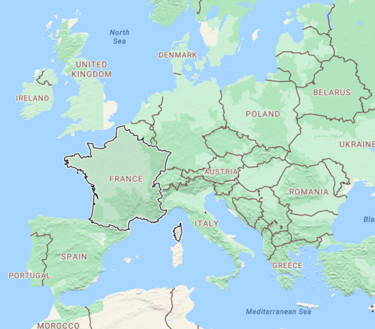
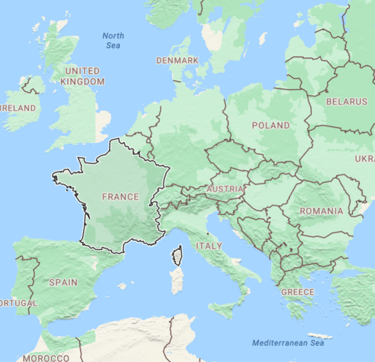
France is located between the longitudinal lines of 42-51 so it is most similar to the states of Oregon and Washington for geography, climate and size. France is a leading agriculture producer and industrial powerhouse. The 2025 population for the country was about 66,607,000.
Though Paris seems to be the most well-known and popular city, the historical and cultural relevance of the country far exceeds this one city. Duchies and principalities of the Middle Ages have dotted “castles” and chateaus all over the country for visitors to enjoy. This Renaissance Architecture draws in tourists and exudes pride from locals. Not interested in buildings?
From the edge of the Alps in the east to the riviera in the south, to the wine country in west, there is something for everyone. France is a food destination where the art of food outshines the quantity of food on a plate. But art is everywhere in this country with ultra-famous examples like Claude Monet, Henri Matisse, Paul Cézanne, and Marc Chagall. You can even find art in the fashion hub of Paris with high end fashion houses like Dior, Louis Vuittan, and Chanel.
Maybe you like science instead of art. France is proud of the work contributed by Marie Curie, Louis Pasteur, Jacques Cousteau, and Blaise Pascal. Their work and that of Leonardo DaVinci can be found all over France. But if History is your vibe, metropolitan France was settled during the Iron age before 51BC. Famous wars have been fought on its soil with memorials preserved. Famous treaties have been signed here too. So all-in-all, France is a great place to visit.Tourism grew rapidly from the 1960s to present day. At the end of the 20th century, it was estimated that 70 million foreign tourists traveled through France each year. But oddly, the tourism industry is not distributed evenly. Again, Paris attracts the most visitors due to its popularity and ease of access. But France also has a wonderful train system that can spread tourism through much of the country. Yet the unequal impact of tourism on different regions threatens some places for overtourism, especially in the summer months which have the best weather.
France is a country in the European Union and in the Schengen zone so there are rules for travel in this country with and without a visa. In 2026 travelers are required to register with the EES and ETIAS programs for digital and biometric identification. These programs are the wave of the future and will someday replace the passport book and stamp process. Therefore, United States citizens will need to apply online for the ETIAS visa waiver to travel to France and other Schengen countries. Once you have registered, US citizens can visit without a visa for 90 days out of 180 days on a calendar. If you want to spend more time in France, a visa is required. Check out the most current categories and subcategories for visas relating to tourism, studies, business, and family at the French Visa Website https://france-visas.gouv.fr/en-US/
Though France and the US have argued and fought over the years, they are allies and have some interesting agreements for citizens of both countries. One of these is a Social security agreement between USA and France https://www.ssa.gov/international/Agreement_Pamphlets/documents/France.pdf


Click on a location to see our photos and stories about each location.






Where Have We Traveled?
UNESCO World Heritage Sites-FRANCE
Roman Theatre and its Surroundings and the "Triumphal Arch" of Orange
Gulf of Porto: Calanche of Piana, Gulf of Girolata, Scandola Reserve #
Place Stanislas, Place de la Carrière and Place d'Alliance in Nancy
Cathedral of Notre-Dame, Former Abbey of Saint-Rémi and Palace of Tau, Reims
Historic Centre of Avignon: Papal Palace, Episcopal Ensemble and Avignon Bridge
Ancient and Primeval Beech Forests of the Carpathians and Other Regions of Europe *
Lagoons of New Caledonia: Reef Diversity and Associated Ecosystems
The Causses and the Cévennes, Mediterranean agro-pastoral Cultural Landscape
Decorated Cave of Pont d’Arc, known as Grotte Chauvet-Pont d’Arc, Ardèche
The Architectural Work of Le Corbusier, an Outstanding Contribution to the Modern Movement *
Funerary and memory sites of the First World War (Western Front) *
Volcanoes and Forests of Mount Pelée and the Pitons of Northern Martinique
The United Nations Educational, Scientific and Cultural Organization (UNESCO) seeks to encourage the identification, protection and preservation of cultural and natural heritage around the world considered to be of outstanding value to humanity. This is embodied in an international treaty called the Convention concerning the Protection of the World Cultural and Natural Heritage, adopted by UNESCO in 1972.