Portugal
Portugal, or more officially, the Portuguese Republic, officially became a nation in the year 1640 per sources I read. This is after being recognized as an ethnicity and a Kingdom for hundreds of years prior.
The country is located on the Iberian Peninsula in Southwestern Europe. Comparable in size to the US state of Indiana at just over 35,600 sq miles, it stretches more so from North to South. This in turn creates a wider range of climate and temperature than one may think. The Northern portion is approximately 10 degrees Fahrenheit cooler on average than the Southern coast, with larger variations in the Summer months.
Portugal was ruled over by the Romans, Germanic tribes, Visigoths and for over 150 years an Islamic Caliphate prior to 1640. Spain ruled over much of Portugal during the 15th and 16th centuries after the Caliphate was finally expelled. This was the period of extensive naval exploration and conquest by the Portuguese. Their power, influence and naval exploration opened up the rest of Europe to new wealth and trade routes.
Portuguese food, wine and culture are world renowned and definitely on par with any of the more well known and traveled destinations. We can attest to these ourselves, as well as the friendliness and outgoing personalities of the people.
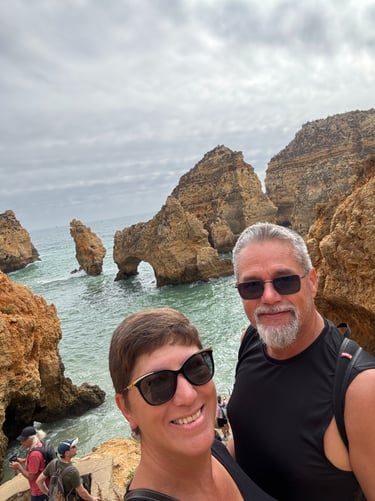
Would we go again? Our experience was on the Southernmost coast, The Algarve as it is referred. We were there from mid-October to mid-November and were absolutely amazed by every aspect. We will most definitely return, especially in the shoulder season. We even saw a few places there that we could see ourselves living for even longer than the one month we spent.
Where Have We Traveled?
Click on a location to see our lived experience (photos and stories) in each location. There are travel nuggets for you too.
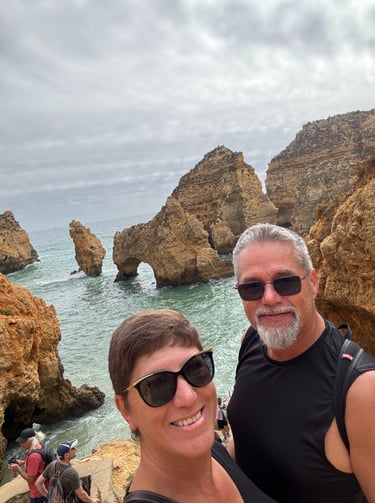
Our city visits included: Logos (homebase), Portimao, Albufiera, Luz, Sagres, Lagoa, Silves, Estombar, Monchique, Aljezur, Faro, Sao Bras de Alportel, Loule, Olhao, Tavira, Alcoutim, and Vila Real de Santo Antonio. We also crossed into Spain for visits in Sanlucar de Guadiana and Ayamonte.
Throughout the entire month we spent in the Algarve Region of Portugal (2025) we visited many cities from the east to west side of southern Portugal.
UNESCO World Heritage Sites-PORTUGAL
The United Nations Educational, Scientific and Cultural Organization (UNESCO) seeks to encourage the identification, protection and preservation of cultural and natural heritage around the world considered to be of outstanding value to humanity. This is embodied in an international treaty called the Convention concerning the Protection of the World Cultural and Natural Heritage, adopted by UNESCO in 1972.