Avoid the Money Misfortunes
Using foreign currency when traveling can be intimidating. Then something goes wrong.
TRAVEL
Make sure you have at least two methods of payment. Any two will do.
phone, credit card, debit card, cash
If you like to pay with plastic, travel with more than one credit/debit card. If one card becomes lost, stolen, or demagnetized, the second card slips in to make the payment.
In several European gas stations, you fill the tank first, then pay. Imagine how you would feel if your only credit card failed to work after you pumped the gas.
Cash is king sometimes. Cash lets you make a purchase from small street vendors. Cash gives you the feeling of being local. Cash minimizes identity theft.
Suppose there is a power outage while you’re in the pharmacy buying cold medicine. Going to the register with cash allows you to complete the purchase even if the power is out.
It was a nightmare. The items were scanned one by one from the conveyor belt. The lady at the store in Hungary showed me my total grocery cost 13.589 Ft ($40). I grabbed my phone and scanned it. No feedback. I did it again. Nothing. I wiped the screen. Nothing. I closed and reopened the app, scanned it again, nothing. The checkers look annoyed as the hurried Christmas shopping line was getting longer. I can’t speak the language. I don’t have cash or credit cards. I can’t pay for my groceries. How can I fix this problem??!!
Thankfully it was not our problem to fix. Unfortunately, an American Gen Z was traveling in Hungary at Christmas and only had his phone as a payment. Technology was not working for him that day. He didn’t speak Hungarian. He didn’t have cash or credit cards. He ended up learning a painful lesson while traveling as he left his groceries behind and walked out of the store.
As payment options become more technologically savvy, not all cities or merchants have evolved. Therefore, when you travel in the USA, Europe, Asia, Canada, etc. you must always have a back-up plan to shift major problems into minor hiccups.
Start with your primary bank debit card and call them before you leave. With a Visa or Mastercard logo, it should be valid overseas, but will they charge a “foreign transaction fee” for vendor purchases? What percentage of the transactions do they charge for that fee? Do they charge any fees for ATM cash withdrawals at foreign banks? Will they reimburse any bank fees associated with cash withdrawals? Are there any rewards for using the debit card for your travel expenses? Do you need to make a travel plan with them to avoid triggering a fraud alert?
Then, contact each of your credit card companies. Do they charge a “foreign transaction fee” on vendor purchases? If so, how are their fees calculated? Are there other fees for ATM cash withdrawals (which is very common even in the home country)?
Additionally, verify which perks they offer? Common examples include: travel miles – cash back – hotel points – airport lounge access – TSA precheck reimbursements-car rental insurance, etc.
Now, decide which cards will be in your travel wallet. Choose the debit or credit cards with minimal or zero fees will be the best way to travel. Keep in mind that the special rewards or perks of some cards may not be as valuable if they also have high transaction fees. Take a few minutes to analyze those differences.
Now, WHICH two (or three) plastic cards should you take?
With your research finished, it’s time to finish packing. But how can you keep your finances safe? The answer is completely individualized and can include these ideas.
Now, let’s hit on the road.
Making purchases in cash makes for a good economics lesson. There are many apps to help you with the conversions to your home currency. You can even find a conversion tool on your Apple Phone Calculator. But if you run out of cash, how do you get more?
RFID wallets and purses.
Money belt under your clothes.
Separation. Keep a credit card and some local cash in the hotel safe, your backpack, or suitcase and separate from your daily wallet in case of an emergency. An outdated driver’s license can be added to this emergency stash as back up ID.
Banks, and sometimes post offices in Europe have ATM machines.
It is safest to use an ATM machine attached to a bank instead of the stand-alone variety on the beach or promenade. There is also one specific brand of stand-alone world-wide ATMs that is widely accused of as having the worst rates, eating cards and not dispensing all the cash it is supposed to, along with other issues.
ATM machines charge different fees for their services ON TOP OF the conversion fee. We saw fees from $5.00-10.00 and have heard that some South America locations have $20 fees. It’s okay to shop for the cheapest bank. Social media groups like Facebook have answered this question repeatedly.
Example: You want €100 from the ATM. Today’s conversion rate is $1.16USD to €1.00 Euro. The bank you chose charges €8.00 per transaction. Therefore, your final cost in USD would total $125.44.
Making purchases by card or phone (tech transactions). Yes, these methods can be faster, easier, and sometimes cheaper. But here are some things to know.
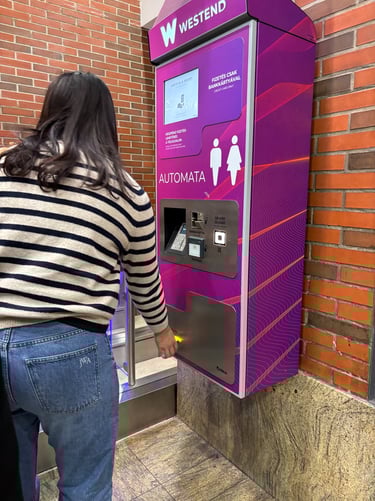
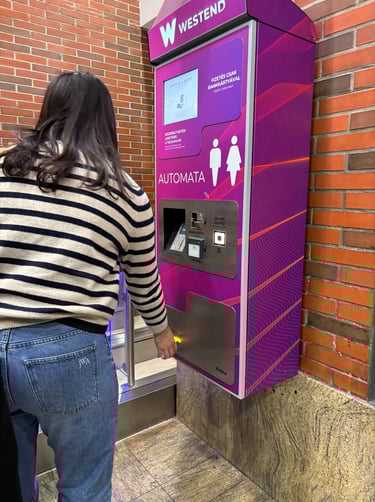
If you read our article Pay To Poo, you will know that in many European countries you must pay to use the toilet. Usually, the payment is with a coin €0,50 to €1,00. This is another reason to keep a little cash on your person when traveling. BUTTTTTTT…sometimes you need a credit card to use the toilet. In our travel, we were required to use a credit card for the public toilet in Pisa, Italy with a whopping €2.00. The most complicated system for public toileting was in a mall in Budapest, Hungary. A bankcard was required at the ticket machine. After we paid, we had to insert the ticket into the carousel gate to enter the toilet rooms. Empty your bladder before it’s too late with this double queuing system.
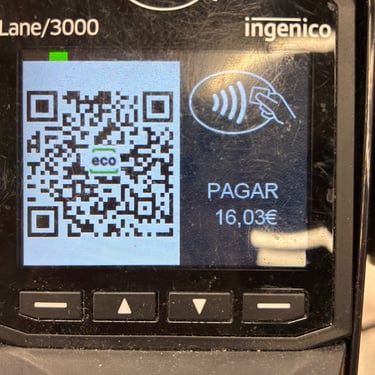
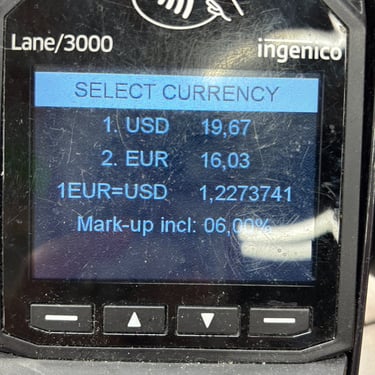
After you tap your card or phone, you will be prompted to pay in your HOME currency or in the LOCAL currency. With this photo example, we were prompted to choose our payment in USD or in Euro. If we chose USD, the store would complete the international conversion and charge us a fee on top of it. The total conversion would be €1,2273741 even though the internation rate for banks that day was €1,1671. Instead, we chose to pay in Euro which then forces the store and the credit card to use the international rate of the day.
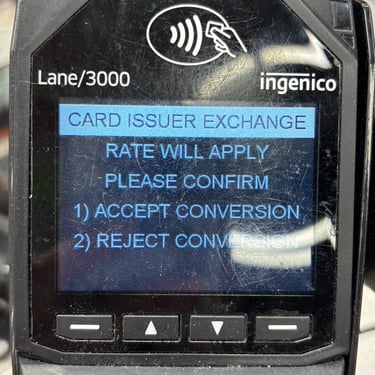
In Portugal, the tap & pay had a secondary prompt which we did not see in any other country. It asked if we wanted to accept the conversion. Believe it or not, this was a secondary way to ask if we wanted the store to do the conversion, just like the description above. The few times we chose “accept the conversion” we paid the €1,2273741. Once we realized the sneaky method, we “rejected conversion” and the transaction was processed in the local currency. Therefore, ALWAYS look at your receipt and make corrections to your behavior as you travel.
Technology varies and some vendors will not accept these methods.
Some vendors charge additional fees for technology transactions.
Visa and Mastercard rule the world. Discover and American Express are not accepted everywhere.
ALWAYS choose to pay in local currency when paying with technology.
Beware of Sniffing or Man in the Middle attacks when using any pay-by-phone AP. Sophisticated hackers can literally intercept the network traffic used by your phone and the seller’s payment device to connect and get your data. This also applies to just surfing the web in public, as they can re-route you through their own fake network and steal your data. We use a VPN to help mitigate the risk as much as we can.
Thankfully, there are many professional travelers and nomads who have talked about currency abroad. Whether you read/watch Rick Steves, Wolter’s World, Brian & Carrie, Finding Gina Marie, or hundreds of others, knowing a little bit before you travel prevents embarrassing interactions and expensive mistakes. Good luck in your next travel adventure.